What Does Hallelujah Mean? Hallelujah in the Hebrew and Greek Bible
One of my favorite ways to study the Bible is to slow down on the original words. Translation is a gift, but some dimensions of meaning get lost along the way. When we understand what a word meant to the people who first sang it, it opens up what it can mean for us now. Hallelujah is one of those words.
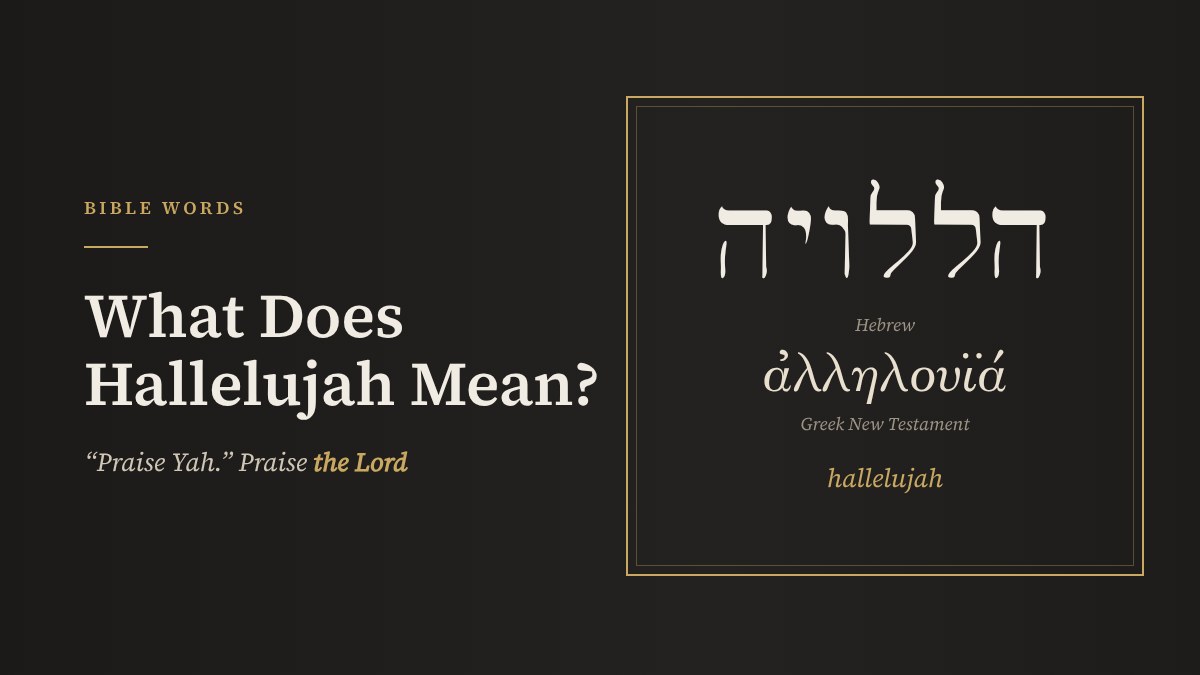
Hallelujah means "praise Yah," a call to praise the Lord. It joins the Hebrew hallelu, "you all praise," with Yah, a short form of God's name, Yahweh. It is not just a feeling. It is an invitation: everyone, praise Him.
Hallelujah is a word I love to say. People will tell me some good news, and before I think about it, it comes out of my gut: "Hallelujah, praise God."
Hallelujah in the Hebrew Bible
Hallelujah lives in the Psalms. The Psalms open and close with praise, and the last five psalms each begin and end with it. The World English Bible translates it "Praise Yah!"
Praise Yah! Praise Yahweh, my soul. While I live, I will praise Yahweh. I will sing praises to my God as long as I exist.
Psalm 146:1-2, World English Bible
Psalms 113 to 118 are known as the Hallel, the "praise" psalms. Jewish families sang them at Passover, and they are most likely the hymn Jesus and His disciples sang at the Last Supper before they went out to the Mount of Olives (Matthew 26:30). The Psalter ends with the widest invitation of all:
Let everything that has breath praise Yah! Praise Yah!
Psalm 150:6, World English Bible
Hallelujah in the Greek New Testament
The New Testament writers kept the Hebrew word and wrote it in Greek letters, allēlouia. That is where the form "alleluia" comes from. It appears in only one chapter, Revelation 19, and there it appears four times. After everything that opposes God has fallen, John hears heaven erupt:
After these things I heard something like a loud voice of a great multitude in heaven, saying, “Hallelujah! Salvation, power, and glory belong to our God:
Revelation 19:1, World English Bible
I heard something like the voice of a great multitude, and like the voice of many waters, and like the voice of mighty thunders, saying, “Hallelujah! For the Lord our God, the Almighty, reigns!
Revelation 19:6, World English Bible
The song Israel sang on the way up to the temple is the song the whole church will sing at the end of the story. Every hallelujah we say now is practice for that day.
Praising in the Hard Seasons
But my desire to praise God was truly tested. Six months into planting our church in Buckhead, my wife Hannah entered a challenging season with her health. We both refused to stop praising God in the middle of it. We are still in that season, and we are still determined to praise Him.
When Job lost almost everything in a single day, he fell down and worshiped.
Then Job arose, and tore his robe, and shaved his head, and fell down on the ground, and worshiped. He said, “Naked I came out of my mother’s womb, and naked shall I return there. Yahweh gave, and Yahweh has taken away. Blessed be Yahweh’s name.”
Job 1:20-21, World English Bible
Later, in the depths of his suffering, he said what many of us know from the King James Version: "Though he slay me, yet will I trust in him" (Job 13:15, KJV). When we go through testing, one of the great principles of the Kingdom is to keep praising God no matter what.
Sometimes praise breaks the chains. Paul and Silas were beaten and thrown into prison, and at midnight they were praying and singing hymns. The earth shook, the doors opened and everyone's chains fell off (Acts 16:25-26). Sometimes we praise in the fiery furnace, and the Lord stands with us in the fire, as He did with Shadrach, Meshach and Abednego (Daniel 3:24-25).
Hebrews 11 tells of people who by faith shut the mouths of lions, and of others who suffered terribly by faith, "of whom the world was not worthy" (Hebrews 11:33-38). Both kinds of faith are honored there. In every outcome, our answer is the same: Hallelujah.
What Hallelujah Means for You
Hallelujah is a command and an invitation. You do not have to wait until you feel like praising. Start with one honest sentence: "Lord, You are good, and I will praise You today." Say it on the good days, and say it on the hard ones. Praise does not deny what is happening. It declares who is still on the throne.
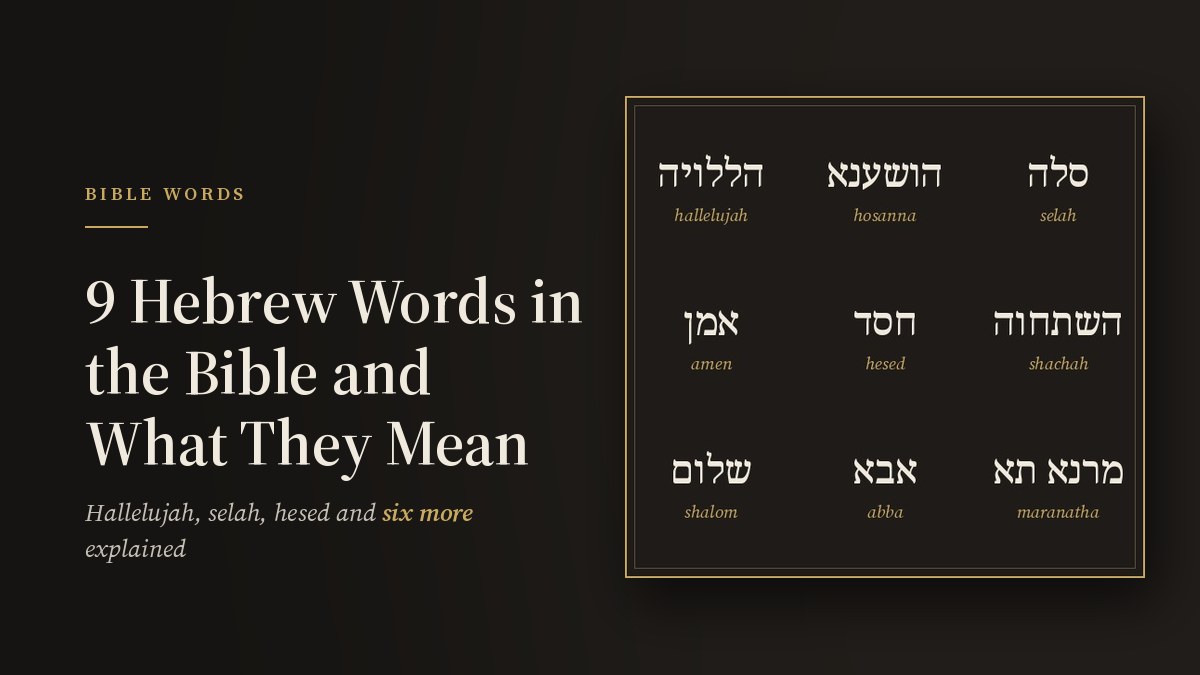
Go deeper. Hallelujah is one of 9 Hebrew Words in the Bible and What They Mean. Read the companion posts on amen, hosanna and selah, or read What Is Worship?
Scripture quotations are from the World English Bible (public domain) unless noted.