9 Hebrew Words in the Bible and What They Mean: Hallelujah, Selah, Hesed and More
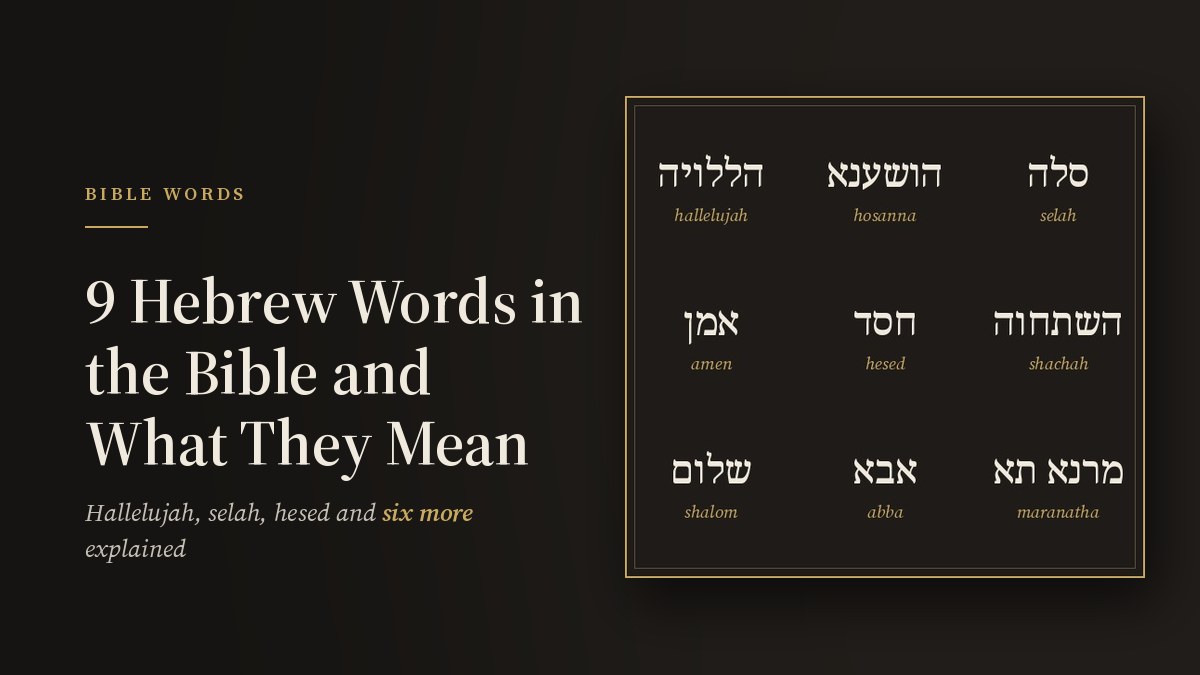
Some of the most important words in the Bible were never translated. They came straight from Hebrew, or from Aramaic, the everyday language of Jesus' time, into our Bibles and our worship songs. We say them every Sunday, often without knowing what they mean. Here are nine of them, what they meant to the people who first spoke them, and what they have come to mean to me.
Jump to a word: Hallelujah · Hosanna · Selah · Amen · Hesed · Shachah (worship) · Shalom · Abba · Maranatha
Hallelujah: "Praise the Lord"
Hallelujah means "praise Yah," a call to praise the Lord. It joins the Hebrew hallelu, "you all praise," with Yah, a short form of God's name, Yahweh. It is not just a feeling. It is an invitation: everyone, praise Him. The Psalms open and close with it, and the last five psalms each begin and end with it.
Let everything that has breath praise Yah! Praise Yah!
Psalm 150:6, World English Bible
The World English Bible translates it "Praise Yah!" In the New Testament it appears only in Revelation 19, where the crowds of heaven shout "Hallelujah!" around the throne.
Hallelujah is a word I love to say. People will tell me some good news, and before I think about it, it comes out of my gut: "Hallelujah, praise God."
But my desire to praise God was truly tested. Six months into planting our church in Buckhead, my wife Hannah entered a challenging season with her health. We both refused to stop praising God in the middle of it. We are still in that season, and we are still determined to praise Him.
When Job lost almost everything in a single day, he fell down and worshiped.
Then Job arose, and tore his robe, and shaved his head, and fell down on the ground, and worshiped. He said, “Naked I came out of my mother’s womb, and naked shall I return there. Yahweh gave, and Yahweh has taken away. Blessed be Yahweh’s name.”
Job 1:20-21, World English Bible
Later, in the depths of his suffering, he said what many of us know from the King James Version: "Though he slay me, yet will I trust in him" (Job 13:15, KJV). When we go through testing, one of the great principles of the Kingdom is to keep praising God no matter what.
Sometimes praise breaks the chains. Paul and Silas were beaten and thrown into prison, and at midnight they were praying and singing hymns. The earth shook, the doors opened and everyone's chains fell off (Acts 16:25-26). Sometimes we praise in the fiery furnace, and the Lord stands with us in the fire, as He did with Shadrach, Meshach and Abednego (Daniel 3:24-25).
Hebrews 11 tells of people who by faith shut the mouths of lions, and of others who suffered terribly by faith, "of whom the world was not worthy" (Hebrews 11:33-38). Both kinds of faith are honored there. In every outcome, our answer is the same: Hallelujah.
Hosanna: "Save Us Now"
Hosanna means "save, please" or "save us now." It comes from the Hebrew hoshia na in Psalm 118, a psalm pilgrims sang going up to the temple.
Save us now, we beg you, Yahweh! Yahweh, we beg you, send prosperity now. Blessed is he who comes in Yahweh’s name! We have blessed you out of Yahweh’s house.
Psalm 118:25-26, World English Bible
When Jesus rode into Jerusalem on Palm Sunday, the crowds quoted this very psalm, crying "Hosanna to the son of David!" (Matthew 21:9). A cry for rescue became a shout of praise, because the One who saves had arrived. When we sing hosanna, we are doing both: asking Jesus to save, and celebrating that He does.
Selah: Pause and Listen
Selah is a Hebrew word that appears about seventy times in the Psalms and three times in Habakkuk. No one knows its exact meaning for certain. Most scholars think it was a musical or liturgical marker, probably a pause, a lifting of the voice or instruments, or a moment to reflect before the song went on.
“Be still, and know that I am God. I will be exalted among the nations. I will be exalted in the earth.” Yahweh of Armies is with us. The God of Jacob is our refuge. Selah.
Psalm 46:10-11, World English Bible
I think of selah as the pause between moments, where we really get in touch with the presence of the living God.
For a season I regularly went on quarterly retreats, and we would have times of "entering into the great silence": whole afternoons spent in silence and solitude. Nothing tested my life of prayer more than that uninterrupted time with God. I would pray every phrase, every thought, every request I had. I can be talkative, so I could go a long time. But eventually my words would run out. And there, in the silence, I would finally get to the bottom of the feelings, thoughts and desires I really longed to pray.
That is selah. Not empty quiet, but making room for God.
Amen: "It Is Firm"
Amen means "so be it," "truly," or "it is firm." It comes from the Hebrew root aman, which carries the idea of being solid, reliable and trustworthy. The same root gives us the Hebrew words for faith and faithfulness. When Israel heard God's word read, the people answered "Amen" (Nehemiah 8:6).
When we say amen, we are agreeing with God and putting our weight on what He said. Paul says every promise of God finds its yes in Jesus, "Therefore also through him is the 'Amen'" (2 Corinthians 1:20). Jesus even calls Himself "The Amen, the Faithful and True Witness" (Revelation 3:14). He is the One we can stand on.
Hesed: God's Loyal Love
Hesed (also spelled chesed) means loyal love, covenant love, steadfast love or loving kindness. There is not a good single English equivalent. It is love that keeps its promises, love that stays, love that is given even when it can't be returned in full. English Bibles translate it "mercy," "kindness," "steadfast love" and "loving kindness."
Hesed is part of how God describes His own name to Moses:
Yahweh passed by before him, and proclaimed, “Yahweh! Yahweh, a merciful and gracious God, slow to anger, and abundant in loving kindness and truth, keeping loving kindness for thousands, forgiving iniquity and disobedience and sin; and who will by no means clear the guilty, visiting the iniquity of the fathers on the children, and on the children’s children, on the third and on the fourth generation.”
Exodus 34:6-7, World English Bible
David knew this love was pursuing him. "Surely goodness and loving kindness shall follow me all the days of my life" (Psalm 23:6). The word "follow" there can mean to chase. God's hesed is not waiting for us to catch up. It chases us down. Psalm 136 repeats the same line twenty-six times: "for his loving kindness endures forever."
Hesed is a precious word to our family. We named one of our daughters Chesed because we sensed that loyal love would be one of her great characteristics. We have seen it in her life. She is a loyal and fierce lover of others, quick to defend people and stand by their side.
And we love that hesed describes the love God extends to us, even when we can't love Him back the way He has loved us.
Shachah: Worship as Bowing Low
The most common Old Testament word for worship, often written shachah, means to bow down or lay yourself low. It is a word of posture. In one of its first appearances in the Bible, Abraham is about to climb Mount Moriah with Isaac and says, "The boy and I will go yonder. We will worship, and come back to you" (Genesis 22:5). Worship, from the beginning, meant surrender.
Oh come, let’s worship and bow down. Let’s kneel before Yahweh, our Maker, for he is our God. We are the people of his pasture, and the sheep in his care. Today, oh that you would hear his voice!
Psalm 95:6-7, World English Bible
Worship is more than singing. It is bowing our lives before Him. Read more in What Is Worship?
Shalom: Peace and Wholeness
Shalom means peace, but much more than the absence of conflict. It means wholeness, completeness and well-being, everything as it should be. It is the heart of the blessing God told Aaron to speak over Israel.
‘Yahweh bless you, and keep you. Yahweh make his face to shine on you, and be gracious to you. Yahweh lift up his face toward you, and give you peace.’
Numbers 6:24-26, World English Bible
Isaiah calls the coming Messiah the "Prince of Peace" (Isaiah 9:6), and Jesus said, "Peace I leave with you. My peace I give to you" (John 14:27). Shalom is what He restores.
Abba: "Father"
Abba is the Aramaic word for father. It is warm and personal, the word a child uses with a father they trust. It is respectful, but full of affection. Jesus prayed it in Gethsemane: "Abba, Father, all things are possible to you" (Mark 14:36). And because of Jesus, we can pray it too.
For you didn’t receive the spirit of bondage again to fear, but you received the Spirit of adoption, by whom we cry, “Abba! Father!”
Romans 8:15, World English Bible
That changes how we pray. We are not servants hoping to be heard. We are children coming to a Father who loves us.
Maranatha: "Come, Lord"
Maranatha is Aramaic for "Our Lord, come." Paul leaves it untranslated near the end of 1 Corinthians (16:22), which tells us the earliest Christians, even Greek-speaking ones, prayed it in their Lord's own language. The Bible's last prayer says the same thing in Greek:
He who testifies these things says, “Yes, I come quickly.” Amen! Yes, come, Lord Jesus.
Revelation 22:20, World English Bible
Maranatha is the longing of the church for Jesus to return. It is a prayer we can pray every day.
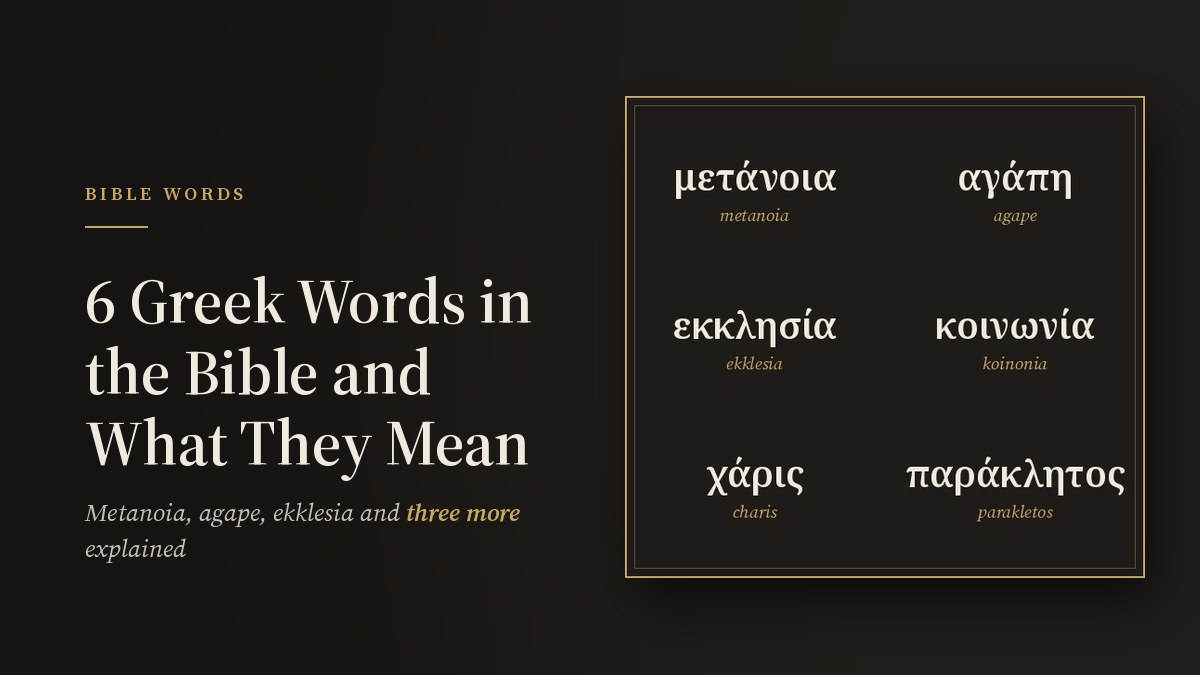
Go deeper. Learn to make room for God in silence with the chapter "Silence: When Prayer Has No Words" in Conversations by Hazen and Hannah Stevens, or start the free Conversations Bible plan. Walk through the Songs of Ascent, fifteen psalms pilgrims sang on the way to worship. And read the companion post, 6 Greek Words in the Bible and What They Mean.
Scripture quotations are from the World English Bible (public domain) unless noted.