
Where Does My Help Come From?
The Maker of the hills keeps you wherever you go.
Incense & Oil · Psalm 121
I look up to the mountains, does my help come from there?
My help comes from the Lord, who made heaven and earth!
He will not let you stumble; the one who watches over you will not slumber.
Indeed, he who watches over Israel never slumbers or sleeps.
The Lord himself watches over you! The Lord stands beside you as your protective shade.
The sun will not harm you by day, nor the moon at night.
The Lord keeps you from all harm and watches over your life.
The Lord keeps watch over you as you come and go, both now and forever.
(Psalm 121, NLT)
Before reading further, read the psalm once more, slowly. Let it be a prayer before it becomes a subject.
The pilgrim at the foot of the hills
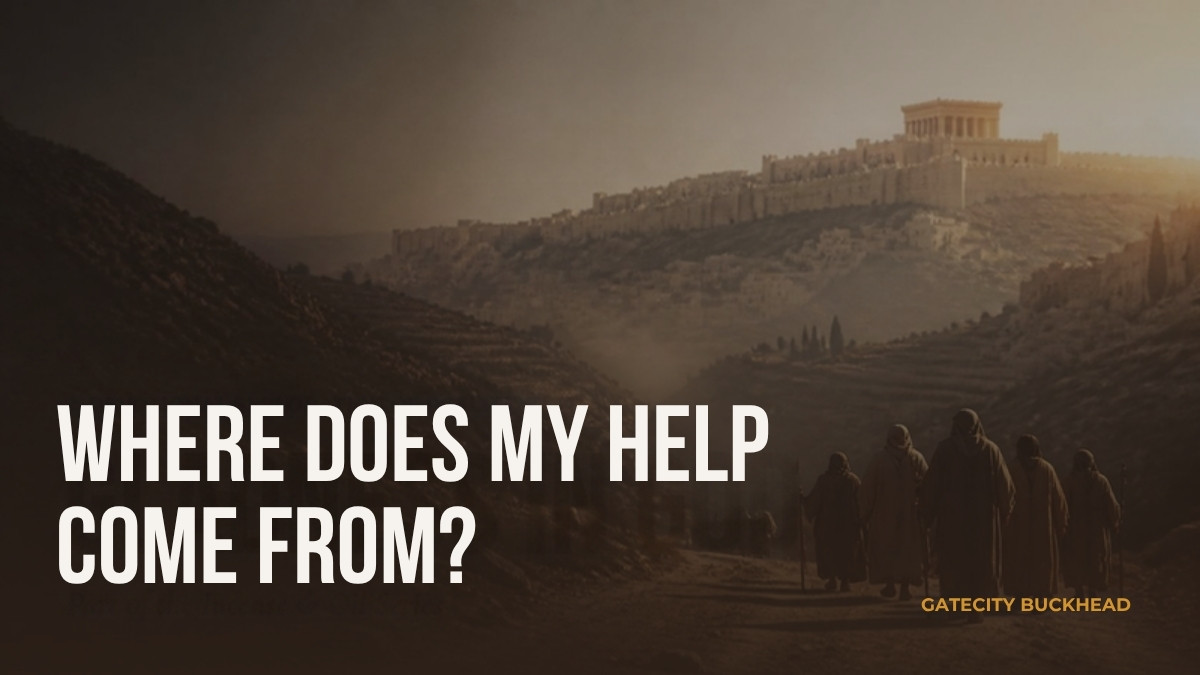
Picture a pilgrim at the end of a long and perilous road. He has come up out of the Judean wilderness. His feet are worn, his water is low, and behind him lie days of exposure, the threat of bandits, and the shrines of foreign gods set on the high places. Now he stands at the foot of the mountains, and he lifts his eyes toward the heights where Jerusalem sits and the house of God rises.
From that place he asks the oldest question of the human heart: Where does my help come from?
It is an honest question. Many of us have stood at the foot of something too large for us, a diagnosis, a debt, a grief, a calling, and asked it ourselves. The psalmist does not hurry past the question. He lets it be asked. Then he answers it.
My help comes from the Lord, who made heaven and earth.
The God who is mindful of you
Sit with the wonder of that answer. The One who made heaven and earth is the One who helps you. The Creator of all things is not distant from the creature who calls to him. Scripture returns to this mystery again and again.
David looked into the night sky and was undone by it:
When I look at the night sky and see the work of your fingers, the moon and the stars you set in place, what are mere mortals that you should think about them, human beings that you should care for them? (Psalm 8:3–4, NLT)
And in Psalm 139 he dares to believe that God's attention toward him is not occasional but constant:
How precious are your thoughts about me, O God. They cannot be numbered! I can't even count them; they outnumber the grains of sand! And when I wake up, you are still with me! (Psalm 139:17–18, NLT)
Isaiah holds both truths together, the frailty of humanity and the faithfulness of God:
"Shout that people are like the grass. Their beauty fades as quickly as the flowers in a field. The grass withers and the flowers fade beneath the breath of the Lord. And so it is with people. The grass withers and the flowers fade, but the word of our God stands forever." (Isaiah 40:6–8, NLT)
Then, in the same chapter, the prophet turns our eyes upward and back to ourselves:
Look up into the heavens. Who created all the stars? He brings them out like an army, one after another, calling each by its name. Because of his great power and incomparable strength, not a single one is missing. O Jacob, how can you say the Lord does not see your troubles? O Israel, how can you say God ignores your rights? Have you never heard? Have you never understood? The Lord is the everlasting God, the Creator of all the earth. He never grows weak or weary. No one can measure the depths of his understanding. He gives power to the weak and strength to the powerless. Even youths will become weak and tired, and young men will fall in exhaustion. But those who trust in the Lord will find new strength. They will soar high on wings like eagles. They will run and not grow weary. They will walk and not faint. (Isaiah 40:26–31, NLT)
The God who calls each star by name has not lost track of you. The uncreated Creator bends toward those who dwell on the earth. The One who needs nothing gives himself to those who need everything.
Pause here and ask: Where have I been looking for help? What would it mean to lift my eyes past those things to the One who made them?
He will not let you stumble
The psalm moves from the heights to the ground beneath the pilgrim's feet. He will not let you stumble. The road to Jerusalem was steep and uneven, and a turned ankle could end a journey. The promise is practical before it is spiritual, and then it is deeply spiritual.
The whole of Scripture echoes it:
You have made a wide path for my feet to keep them from slipping. (Psalm 18:36, NLT)
Let the whole world bless our God and loudly sing his praises. Our lives are in his hands, and he keeps our feet from stumbling. (Psalm 66:8–9, NLT)
They keep you safe on your way, and your feet will not stumble. (Proverbs 3:23, NLT)
And the New Testament gathers the same hope into one of its most beautiful blessings:
Now all glory to God, who is able to keep you from falling away and will bring you with great joy into his glorious presence without a single fault. All glory to him who alone is God, our Savior through Jesus Christ our Lord. All glory, majesty, power, and authority are his before all time, and in the present, and beyond all time! Amen. (Jude 24–25, NLT)
What the pilgrim hoped for on a mountain road, the church receives as a promise for the whole journey of faith. He who began the work is able to keep you to the end.
The keeper who never sleeps
The one who watches over you will not slumber. Indeed, he who watches over Israel never slumbers or sleeps.
Every human guardian eventually tires. Parents fall asleep beside a sick child. Watchmen nod off before dawn. But the One who keeps you is not like us. He does not grow weary, as Isaiah reminded us. He is awake through every watch of the night.
This stands in quiet contrast to the gods of the nations, which the psalmist knew well:
Their idols are merely things of silver and gold, shaped by human hands. They have mouths but cannot speak, and eyes but cannot see. They have ears but cannot hear, and noses but cannot smell. They have hands but cannot feel, and feet but cannot walk, and throats but cannot make a sound. And those who make idols are just like them, as are all who trust in them. (Psalm 115:4–8, NLT)
The idols cannot see you. The living God never takes his eyes off you. And notice the widening circle in the psalm: the One who keeps the single pilgrim is the same One who keeps the whole people of God. Your life is held within a larger keeping.
The watchman on the wall
The Lord himself watches over you!
Three times now the psalm has used this language of watching and keeping, and it lands on us like a refrain. Imagine the pilgrim drawing near to the city. Above him, along the walls of Jerusalem, he sees the watchmen standing guard. I believe the psalmist takes that familiar sight and lifts it into a picture of God himself. As the watchman keeps the city, so the Lord keeps your life.
Isaiah uses the same image for the Lord's tireless care over his people:
O Jerusalem, I have posted watchmen on your walls; they will pray day and night, continually. Take no rest, all you who pray to the Lord. Give the Lord no rest until he completes his work, until he makes Jerusalem the pride of the earth. (Isaiah 62:6–7, NLT)
Out of zeal for his own name and love for his people, God sets watch and does not grow silent. He is the true Watchman behind every watchman.
Pause and consider: What am I trying to guard on my own tonight? Can I hand that watch back to the One who never sleeps?
Your protective shade
The Lord stands beside you as your protective shade.
Anyone who has crossed the wilderness knows the worth of shade. Under a merciless sun, a single shadow can be the difference between collapse and strength to continue. Shade is a place of rest and a place of protection, a place of refreshing and of provision. And it is most precious exactly where it is most scarce.
The psalmists loved this image:
Those who live in the shelter of the Most High will find rest in the shadow of the Almighty. This I declare about the Lord: He alone is my refuge, my place of safety; he is my God, and I trust him. (Psalm 91:1–2, NLT)
God is great enough to overshadow you completely, and near enough to stand at your right hand.
By day and by night
The sun will not harm you by day, nor the moon at night.
The sun's danger is easy to name: heat, thirst, exhaustion. The moon's is harder. Desert nights turn bitterly cold, and the ancient world feared that the moon could disturb the mind; our word lunatic still carries that old belief. Taken together, day and night describe the whole circle of time. There is no hour in which you are unattended.
But there is a deeper layer. Across the ancient world, the sun and the moon were worshiped as gods. A pilgrim passing through foreign lands walked under the shadow of their shrines. The psalm declares that the Maker of the sun and the moon is the One who keeps you, and that no power, visible or invisible, created or worshiped, can overrule his keeping. You are guarded not only from the elements but from every rival claim on your soul.
He will keep your life
For this section, we turn to the English Standard Version, which carries the Hebrew word for keep straight through each passage so you can see the thread for yourself.
The Lord will keep you from all evil; he will keep your life. (Psalm 121:7, ESV)
This keeping has two faces. He guards you from what comes against you, and he watches over you so that you have what you need. Protection and provision are held together in one love.
When God revealed himself to Abram, he gave a name that speaks to this very sufficiency:
When Abram was ninety-nine years old, the Lord appeared to him and said, "I am El-Shaddai, 'God Almighty.' Serve me faithfully and live a blameless life." (Genesis 17:1, NLT)
El-Shaddai is the God who is enough, the God of covenant provision and tender nurture.
The Hebrew word behind keep in Psalm 121 is shamar: to guard, to watch, to tend, to take care of. It appears six times in these eight short verses. And it carries a thread that runs all the way back to the beginning of the story.
The Lord God took the man and put him in the garden of Eden to work it and keep it. (Genesis 2:15, ESV)
Humanity was placed in the garden, the first sanctuary, to keep it. Later, God gave the very same charge to the priests, who were to keep and guard the holy place of his presence:
And you shall keep guard over the sanctuary and over the altar, that there may never again be wrath on the people of Israel. (Numbers 18:5, ESV)
The calling to keep the place of God's presence was given first to Adam, and then to the priests.
Now hear Psalm 121 again:
The Lord is your keeper; the Lord is your shade on your right hand. (Psalm 121:5, ESV)
In the same way God desired humanity to keep the places of worship, he commits himself to keep our lives and care for us. The charge we were given and failed to fulfill, he takes up on our behalf. He tends your life the way a priest tends holy ground. And this is the very word spoken over God's people in the ancient blessing:
The Lord bless you and keep you; the Lord make his face to shine upon you and be gracious to you; the Lord lift up his countenance upon you and give you peace. (Numbers 6:24–26, ESV)
You are kept.
The Lord will keep your going out and your coming in from this time forth and forevermore. (Psalm 121:8, ESV)
As you come and go, both now and forever
That final line opens out into eternity. Our days are brief. James asks us plainly:
How do you know what your life will be like tomorrow? Your life is like the morning fog, it's here a little while, then it's gone. (James 4:14, NLT)
When we commit our lives into God's hands, we entrust to him not only these few days that pass like a vapor, but the everlasting life that comes from him alone. Psalm 139 tells us that he has been keeping watch from the very beginning:
O Lord, you have examined my heart and know everything about me. You know when I sit down or stand up. You know my thoughts even when I'm far away. You see me when I travel and when I rest at home. You know everything I do. (Psalm 139:1–3, NLT)
I could ask the darkness to hide me and the light around me to become night, but even in darkness I cannot hide from you. To you the night shines as bright as day. Darkness and light are the same to you. (Psalm 139:11–12, NLT)
You saw me before I was born. Every day of my life was recorded in your book. Every moment was laid out before a single day had passed. (Psalm 139:16, NLT)
The help that is everywhere
Return one last time to the pilgrim at the foot of the hills. As he prepares to climb toward the temple and worship, he may believe that his help is bound to that place: the hills, the citadel, the sanctuary at the top of the road. And it is good that he climbs. Worship matters. The house of God matters.
But the psalm gently opens his eyes to something larger. The God who made heaven and earth is not confined to Jerusalem. His help is not limited to one mountain. In his omnipresence and omnipotence, his keeping reaches every road and every room. What the pilgrim feels in that one holy moment at the foot of the hills is simply the truth of every moment, in every place, forever.
He began with I look up to the mountains. He ends with the Maker of the mountains keeping his going out and his coming in.
As you close, take a few quiet breaths. Wherever you are going out to today, and wherever you will come home to tonight, receive this: The Lord himself watches over you. You may rest.
Climb with us this month. We are reading all fifteen Songs of Ascent together as a church. Read along here.
Unless otherwise noted, Scripture quotations are taken from the Holy Bible, New Living Translation, copyright © 1996, 2004, 2015 by Tyndale House Foundation. Used by permission of Tyndale House Publishers, Carol Stream, Illinois 60188. All rights reserved. Scripture quotations marked ESV are from the ESV® Bible (The Holy Bible, English Standard Version®), © 2001 by Crossway, a publishing ministry of Good News Publishers. Used by permission. All rights reserved.