What Is a Non-Denominational Church? Meaning, History, and How to Tell a Healthy One
In this post: What is a non-denominational church? · Where did non-denominational churches come from? · How is a non-denominational church led and held accountable?
A non-denominational church is a Christian church that is not part of, or governed by, a denomination such as Baptist, Methodist, Presbyterian, or Lutheran. It usually holds the core beliefs that Christians have always shared, like the authority of the Bible, the Trinity, and salvation through Jesus, but it sets its own leadership, practices, and statement of faith instead of receiving them from a denominational headquarters.
That is the short answer. But “non-denominational” describes what a church is not more than what it is. Two non-denominational churches can be very different from each other. So it helps to know a little history, what most of them believe, and especially how they are led.
A Brief History
Christians have long wanted to be known simply as followers of Jesus rather than by a label. In the early 1800s, the Restoration Movement in America called believers to be “Christians only” and to leave denominational divisions behind. Through the 1900s, independent Bible churches and community churches multiplied.
The 20th century also brought a wave of renewal in the Holy Spirit. It began with the Azusa Street Revival in Los Angeles in 1906, which launched the modern Pentecostal movement, and continued through the charismatic renewal of the 1960s and the Jesus Movement of the 1970s. Many of the churches born in those moves of God were independent from the start. Some later grew into networks of their own.
Today non-denominational churches are the fastest-growing part of American Protestantism. The 2020 U.S. Religion Census counted more than 44,000 non-denominational congregations with about 21 million adherents, making them the largest Protestant group in the country by adherents.
What Do Non-Denominational Churches Believe?
There is no single statement of faith, because there is no single governing body. But most non-denominational churches hold to historic Christian belief:
- The Bible is the inspired Word of God and the final authority for faith and life.
- God is one God in three persons: Father, Son, and Holy Spirit.
- Jesus is fully God and fully man. He died for our sins, rose from the dead, and is coming again.
- Salvation is by grace through faith in Jesus, not by our own works.
- Baptism and communion are practiced as the church’s ordinances.
There is one body, and one Spirit, even as you also were called in one hope of your calling; one Lord, one faith, one baptism, one God and Father of all, who is over all, and through all, and in us all.
Ephesians 4:4-6, World English Bible
Where they differ is in style and emphasis. Some are quiet and teaching-centered. Others are Spirit-filled (sometimes called charismatic), with expressive worship and an expectation that the gifts of the Holy Spirit are active today. That is why the best way to know a church is to read its beliefs page and visit.
Don’t Skip This: How Is the Church Led?
Here is the question many people never think to ask. Denominations come with built-in oversight: bishops, presbyteries, or conventions that can step in when something goes wrong. A non-denominational church has to build that accountability itself. So its ecclesiology, the way a church is structured and governed, matters a great deal.
Most non-denominational churches follow one of a few models:
- Elder-led. A team of elders shares oversight of the church. The senior pastor is usually one of the elders and leads among them, but does not lead alone.
- Senior-pastor-led. The senior pastor carries the primary vision and authority, usually with a board that handles finances and accountability.
- Congregational. Members vote on major decisions such as leaders and budgets.
- Network or apostolic oversight. The church is independent but in covenant relationship with outside leaders or a family of churches who provide counsel and correction.
Shepherd the flock of God which is among you, exercising the oversight, not under compulsion, but voluntarily, not for dishonest gain, but willingly; neither as lording it over those entrusted to you, but making yourselves examples to the flock.
1 Peter 5:2-3, World English Bible
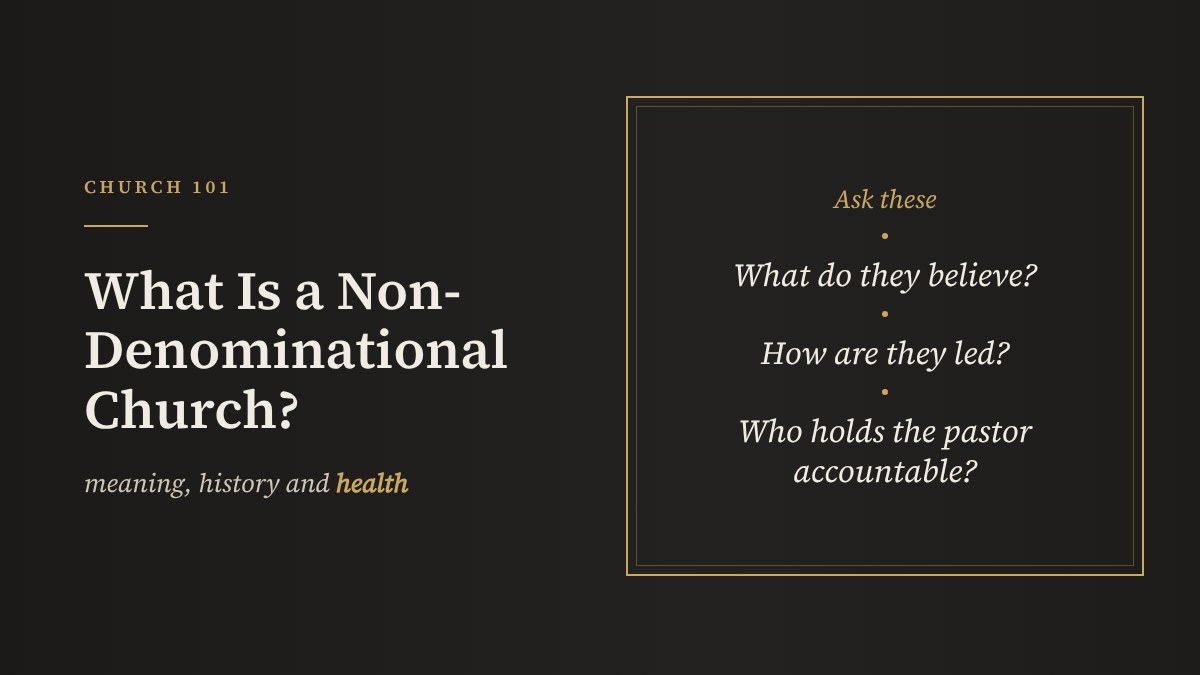
Any of these can be healthy, and any of them can be abused. So it is fair, and wise, to ask a few questions:
- Is the church elder-led or senior-pastor-led?
- Who does the senior pastor answer to? Could anyone correct or remove the senior pastor if needed?
- Is there outside oversight, like a network, overseers, or a board that includes people who are not on staff?
- Are finances reviewed and reported openly?
- How are leaders chosen and trained?
The answers will tell you a lot. Not just what a church believes, but how it actually functions.
Marks of a Healthy Non-Denominational Church
- A clear statement of faith that is easy to find and rooted in historic Christian belief.
- Real accountability for leaders, including the senior pastor.
- The Bible taught faithfully, week after week.
- Worship focused on God, not on performance.
- Room for the Holy Spirit, who is honored as a Person, not treated as an idea.
- Connection to the wider Church. Independent does not have to mean isolated. Healthy churches partner with other churches and leaders.
- Disciple-making, not just attendance. People are growing, serving, and being sent.
- Transparency and care, including open finances and clear policies that keep children and vulnerable people safe.
If you are visiting churches, my article on your first Sunday at church walks through what to expect and how to tell if you have found a good church.
Want to Go Deeper?
If you would like to understand the modern church and especially the work of the Holy Spirit over the last century, here are a few good places to start:
- The Charismatic Century: The Enduring Impact of the Azusa Street Revival by Jack Hayford and S. David Moore. A readable history of the Pentecostal and charismatic renewals and how they shaped the church today.
- Heaven Below: Early Pentecostals and American Culture by Grant Wacker. A deeper historical study of early Pentecostalism.
- Biblical Eldership by Alexander Strauch. A thorough case for elder-led church government.
- Nine Marks of a Healthy Church by Mark Dever. A practical look at what makes a church healthy.
You will not agree with every author on every point, and that is okay. Reading across traditions will help you think more clearly about the church.
GateCity Buckhead
GateCity Buckhead is a non-denominational, Spirit-filled church in Buckhead, Atlanta. We are centered on Jesus and the Bible, and you can read what we believe. If you have questions about how our church is led, please ask. We would be glad to answer.
Don’t Know Where to Go to Church This Sunday?
Come be with us. We would love to see you. GateCity Buckhead gathers Sundays at 11am at Atlanta International School, 2890 N Fulton Dr NE, and we will save you a front-row parking spot. Plan your visit.
Not in Atlanta, or not quite ready to walk through the doors? Worship online with our church family every Sunday at 11am Eastern. Join us online, and stay connected through the week in our digital community.
Keep going. Read Your First Sunday at Church, What Is the Gospel?, and Is the Holy Spirit a Person?
Scripture quotations are from the World English Bible (public domain).