The 9 Gifts of the Holy Spirit: A Practical Guide
In this post: What are the 9 gifts of the Holy Spirit? · Are there 7 gifts or 9? · How do I start operating in the gifts?
The nine gifts of the Holy Spirit, listed in 1 Corinthians 12:8-10, are the word of wisdom, the word of knowledge, faith, gifts of healings, working of miracles, prophecy, discerning of spirits, different kinds of tongues, and the interpretation of tongues. They are supernatural ways the Spirit works through ordinary believers to help people and point them to Jesus.
But to each one is given the manifestation of the Spirit for the profit of all. For to one is given through the Spirit the word of wisdom, and to another the word of knowledge, according to the same Spirit; to another faith, by the same Spirit; and to another gifts of healings, by the same Spirit; and to another workings of miracles; and to another prophecy; and to another discerning of spirits; to another different kinds of languages; and to another the interpretation of languages. But the one and the same Spirit produces all of these, distributing to each one separately as he desires.
1 Corinthians 12:7-11, World English Bible
Paul opens this chapter by saying he does not want us to be ignorant about spiritual gifts. I have found that simply learning what the gifts are is often where faith starts to stir. So here is a practical overview: what each gift is, what it looks like today, and how to begin.
Are There 7 Gifts of the Holy Spirit or 9?
You may have heard of the seven gifts of the Holy Spirit. That list comes from Isaiah 11, a prophecy about the Messiah, and it is taught in the Catholic tradition as wisdom, understanding, counsel, fortitude, knowledge, piety and fear of the Lord.
Yahweh’s Spirit will rest on him: the spirit of wisdom and understanding, the spirit of counsel and might, the spirit of knowledge and of the fear of Yahweh.
Isaiah 11:2, World English Bible
Both lists are biblical, and they describe different things. Isaiah 11 describes the character of the Spirit resting on Jesus, and on us as we are formed in Him. 1 Corinthians 12 describes the power of the Spirit working through us to help others. This post is about the nine.
Three Kinds of Gifts
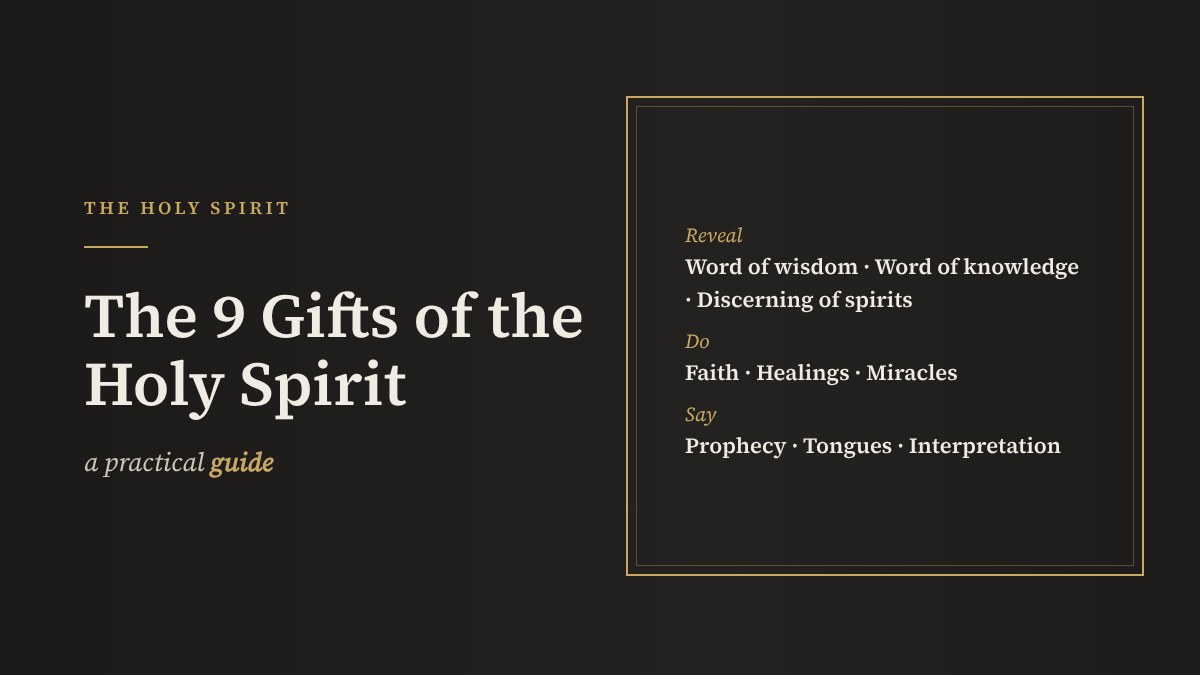
It helps to see the nine in three groups:
- Gifts that reveal something: word of wisdom, word of knowledge, discerning of spirits.
- Gifts that do something: faith, working of miracles, gifts of healings.
- Gifts that say something: prophecy, different kinds of tongues, interpretation of tongues.
In real life they rarely work alone. A word of knowledge stirs faith, faith releases healing, and a prophetic word helps someone receive it. I like to think of them less like tools in a toolbox and more like instruments in a symphony, with the Holy Spirit as the conductor.
Gifts That Reveal Something
1. The Word of Knowledge
A word of knowledge is a piece of information the Spirit reveals about the past or present that you could not have known naturally. Notice it is called a word of knowledge, not the gift of knowledge. It is a fragment, not the whole picture. Jesus told the woman at the well about her five husbands (John 4:18), and that one sentence opened her heart.
What it looks like today: you are praying for someone and a name, a body part or a situation comes to mind. You gently ask, "Does this mean anything to you?" and it opens the door for God to meet them.
2. The Word of Wisdom
A word of wisdom is revelation about the future, or God’s wisdom for what to do next. Agabus foretold a coming famine, and the church sent relief ahead of time (Acts 11:28-30). Philip was told to go to the desert road, and he met an Ethiopian official ready to hear the gospel (Acts 8:26-29).
What it looks like today: a sense of direction for a decision, a timely warning, or a next step that turns out to be exactly right.
3. Discerning of Spirits
Discerning of spirits is insight into the spiritual realm: perceiving whether what is at work in a situation is the Holy Spirit, a human spirit, or an evil spirit. It is more than reading people or spotting their faults. Paul discerned the spirit behind the fortune-telling slave girl in Philippi and set her free (Acts 16:16-18).
What it looks like today: recognizing what is really going on beneath the surface, so you know how to pray.
Gifts That Do Something
4. The Gift of Faith
The gift of faith is a supernatural confidence that God will act, often bringing protection, provision or direction you could not have arranged. Daniel was kept safe in the lions’ den (Daniel 6), Elijah was fed by ravens (1 Kings 17), and Paul was protected in the storm (Acts 27).
What it looks like today: a deep, settled certainty in a crisis, exact provision for a need, or divine appointments you could not have planned.
5. Gifts of Healings
In the original Greek, both "gifts" and "healings" are plural. Healing comes in many forms and often unfolds as a process. Jesus healed in different ways every time, and He has not stopped.
What it looks like today: laying a hand on someone’s shoulder, praying a simple prayer, and asking, "How do you feel now?" Then thanking God for every bit of improvement.
6. The Working of Miracles
A miracle is a supernatural intervention in the ordinary course of nature, usually instant. Jesus turned water into wine (John 2) and fed the five thousand (John 6). Here is a helpful contrast: the gift of faith kept Paul safe in the storm, while the working of miracles is Jesus rebuking the storm so it stopped.
What it looks like today: moments where God changes the circumstances themselves, beyond any natural explanation.
Gifts That Say Something
7. Prophecy
Prophecy is speaking a message from God to strengthen, encourage and comfort people. Paul tells us to earnestly desire it above the other gifts because it builds up the church, and he says everyone can prophesy (1 Corinthians 14:1, 31).
But he who prophesies speaks to men for their edification, exhortation, and consolation.
1 Corinthians 14:3, World English Bible
What it looks like today: an encouraging word, a picture, or a Scripture that lands exactly where someone is.
8. Different Kinds of Tongues
Tongues is speaking in a language you have not learned, whether a human language or what Paul calls the tongues of angels (1 Corinthians 13:1). There is a difference between tongues in your private prayer life, which builds you up (1 Corinthians 14:2-4), and a message in tongues for the church, which should be interpreted.
What it looks like today: a private prayer language that strengthens your walk with God, and occasionally a public message in a gathering. For more, see What Is Speaking in Tongues?
9. Interpretation of Tongues
Interpretation is the Spirit-given ability to express the meaning of a message in tongues. It is more than translating words. It conveys God’s heart and burden behind the message so the whole church is built up.
What it looks like today: after a message in tongues, someone shares what the Lord is saying in plain language, often bringing great encouragement.
How the Spirit Usually Speaks
God can speak in dramatic ways: dreams, visions, angelic encounters, even an audible voice. But the most common way is subtle. Elijah found that the Lord was not in the wind, the earthquake or the fire, but in a still small voice (1 Kings 19:11-12). The gifts often start as faint impressions like these:
- Mental pictures: an image that comes to mind as you pray for someone.
- Emotional stirrings: a sudden joy, sadness or burden for a person that hints at how God wants to touch them.
- Sympathetic pains: a brief pain in part of your body that points to something God wants to heal in someone else.
- Physical sensations: warmth, energy or a sense of the Spirit’s presence that signals what He is doing.
These impressions are easy to dismiss because they are small. But one small impression can be the key that opens a door.
How to Start Growing in the Gifts
- Earnestly desire them. We rarely operate in the gifts until we want them. Ask God for them, and use them in the day of small beginnings.
- Ask, "Holy Spirit, what are You doing?" Jesus only did what He saw the Father doing (John 5:19). Asking puts up your sail, so even a gentle breeze of the Spirit can move you.
- Quiet your soul. When you pray for someone, don’t preach your prayers or work yourself up. Slow down and listen.
- Value small measures. If someone’s headache is ten percent better, that is still God’s power. Thank Him for it. Humility is faithful in small things.
- Don’t fear missing it. The bigger risk is never stepping out at all. What if it really was God, and someone missed His touch because you held back?
- Use gentle language. You don’t have to say, "Thus says the Lord." Try, "I’d love to pray for you. I believe God wants to touch you." If you are wrong, no one gets hurt.
- Don’t force it. Your job is to stay open to the Spirit, not to come up with something.
Keep It Relational
The gifts are not techniques to master. They flow from a relationship with the Holy Spirit, who is a Person. They are given for the good of others, not our own platform. And they work by faith. I unpack those three principles in Understanding the Gifts of the Holy Spirit.
Start this week. Before you walk into a meeting, a coffee shop or your own kitchen, pray a simple prayer: "Holy Spirit, what do You want to do or say through me today?" Then pay attention.
Go deeper. Read Is the Holy Spirit a Person? and How to Be Filled With the Holy Spirit, watch the Manifest series free, or get the book Manifest on Amazon. If you are in Atlanta, join us Sundays at 11am in Buckhead.
Scripture quotations are from the World English Bible (public domain).